Why Smart Locks Are Trending in Home Security in 2026
Home security is becoming increasingly connected, and the humble door lock is now part of that transformation. Traditional locks rely primarily on a physical key, while smart locks can offer keyless entry, temporary credentials, activity notifications, automatic locking, and app-based access depending on the product and ecosystem.
Are smart locks more secure than traditional locks?
Not automatically. Security depends on the lock quality, installation, authentication, software security, and maintenance
For homeowners comparing a smart lock vs traditional lock, the decision is not simply about choosing newer technology. A good lock must still provide dependable physical security while fitting the door, household routine, and access requirements. Industry standards such as ANSI/BHMA evaluate residential locks for characteristics including durability, strength, and security, while noting that real-world performance also depends on installation, door construction, maintenance, and environmental conditions.
Smart-home cybersecurity is another consideration in 2026. NIST’s updated IoT guidance emphasizes security capabilities, customer information, maintenance, and support throughout the product lifecycle.
So, is upgrading worthwhile? It depends on what you expect from your home’s entry system.
Smart Locks vs Traditional Locks: Features, Security, Cost & Benefits
1. What Are Smart Locks and How Do They Work?
A smart lock is an electronically controlled locking system that can provide one or more alternatives to a conventional physical key. Depending on the model, access may be provided through a PIN, fingerprint, RFID card, smartphone, key tag, voice assistant, or mechanical key override.
What happens when a smart lock battery dies?
Many models provide low-battery alerts, emergency power, or a mechanical key override, depending on the product.
Some connected models can also provide information about whether the door is locked and allow homeowners to manage users remotely. For example, Yale’s connected products offer combinations of app access, PINs, RFID, fingerprints, activity information, and mechanical emergency access depending on the model.
A typical smart-lock setup includes:
- Electronic lock mechanism
- Battery or wired power source
- Access-control method
- Mobile application or local controller
- Optional Wi-Fi/Bluetooth/Zigbee or other connectivity
- Emergency/manual access mechanism
This makes a digital lock vs key lock comparison more nuanced: the smart option adds electronic functionality, but the underlying physical lock and installation remain important.
2. Smart Lock Features: Keyless Entry, App Control & Access Management
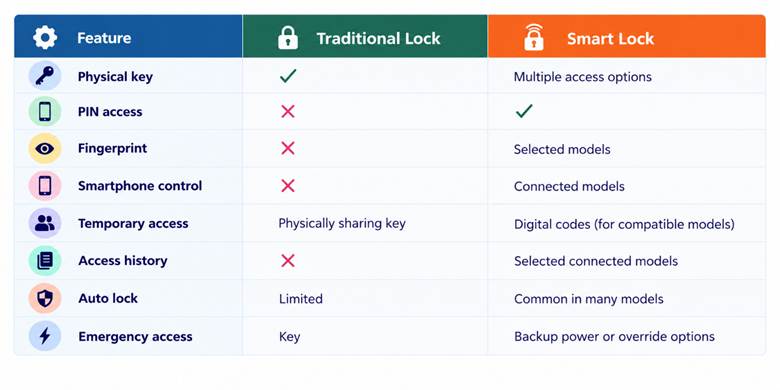
The biggest attraction of smart locks is flexibility. Instead of distributing physical keys to every family member, homeowners can use different credentials where supported.
Common features include:
- PIN access: Enter a personalized code.
- Fingerprint access: Use biometric authentication on supported models.
- RFID/key tags: Convenient for regular users.
- Mobile access: Lock or unlock through a compatible app.
- Temporary access: Create credentials for guests or service providers.
- Activity history: Some connected systems record locking and unlocking activity.
- Auto-lock: Automatically secure the door after a configured period.
- Emergency access: Mechanical key or external emergency power on supported products.
These features can be particularly useful for families, rental properties, home offices, and homeowners who frequently need to provide temporary access.
3. Smart Locks vs Traditional Locks: Security, Convenience & Reliability
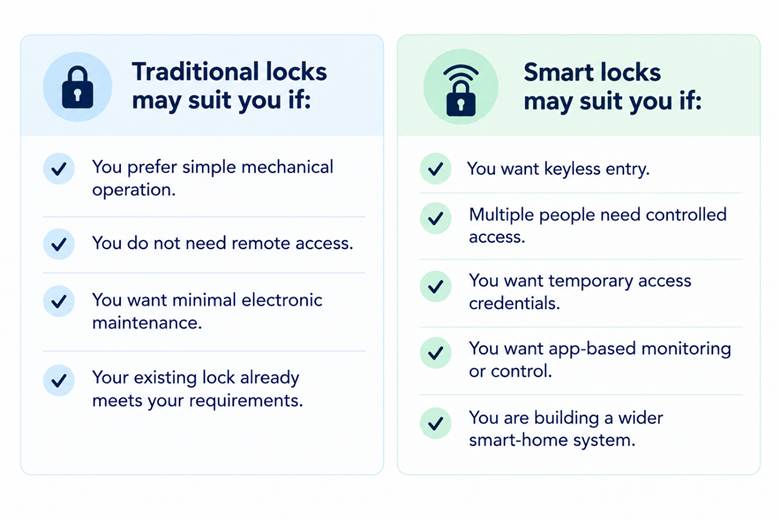
A smart lock should not automatically be considered more secure simply because it is digital. Security depends on the physical lock, electronic design, authentication, installation, software support, and how the homeowner configures the system.
Traditional locks have an important advantage: their operation does not depend on batteries, apps, internet connectivity, or electronic components.
Smart locks, meanwhile, can provide access-management benefits that traditional locks cannot easily replicate.
NIST has highlighted privacy and security considerations associated with smart-home devices, including the importance of understanding device security and taking appropriate protective measures.
Therefore, customers should check whether a smart lock receives software/security updates, how accounts are protected, what data is collected, and what happens if the battery or connectivity fails.
4. Smart Lock Installation, Compatibility & Maintenance: What to Know
Before buying a smart lock, check whether it is compatible with your existing door and locking mechanism. Door thickness, mortise dimensions, backset, handle configuration, and lock type can affect installation.
Professional installation can also matter because even a high-quality lock may perform poorly if the door or frame is misaligned.
Check these points before installation:
- Door thickness and lock dimensions
- Existing mortise/deadbolt compatibility
- Door and frame alignment
- Battery accessibility
- Emergency unlocking method
- Smart-home platform compatibility
- Wi-Fi/Bluetooth requirements
- Manufacturer support and software updates
Battery management should not be overlooked. Some manufacturers provide low-battery alerts and emergency power terminals; Yale, for example, specifies emergency power options on several Indian-market smart locks.
5. Smart Lock Cost in 2026: Is the Upgrade Worth It?
There is no single meaningful price for a smart lock because costs vary by lock type, authentication technology, connectivity, installation, brand, and integration requirements.
Rather than comparing only the purchase price, consider the total ownership value.
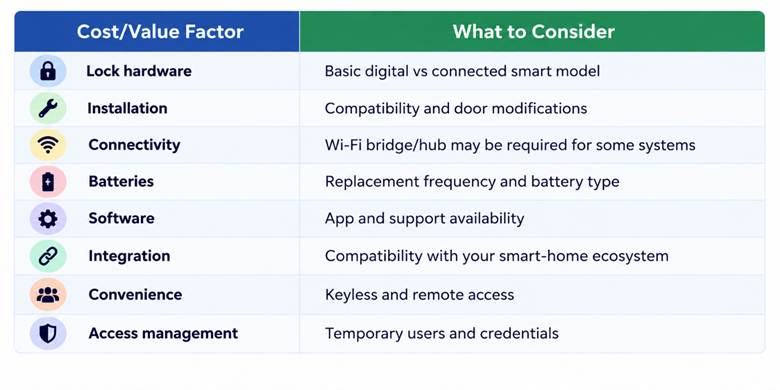
For example, some smart-lock ecosystems require additional modules or bridges for remote control and voice-assistant functionality.
This is why searching for the Best Smart Locks in Bangalore should not mean choosing the product with the most features. The better purchasing process is to match the lock’s specifications, security features, installation requirements, support, and connectivity with your actual home.
Conclusion
Are Smart Locks Worth It in 2026? Key Factors to Consider
Smart locks can provide meaningful advantages for homeowners who value keyless entry, flexible access management, remote control, activity information, and smart-home integration. However, traditional locks remain a practical choice when simplicity, mechanical operation, and minimal maintenance are the priorities.
Can smart locks be controlled remotely?
Some connected smart locks support remote control through an app, but a Wi-Fi bridge, hub, or additional module may be required.
The most important lesson from a digital lock vs key lock comparison is that technology alone does not determine security. Physical lock quality, correct installation, door construction, authentication, software support, battery management, and emergency access all matter.
If your priority is convenience and connected access, a smart lock can be a useful upgrade. If your current traditional lock already meets your needs and you do not require connected features, upgrading may offer less practical value.
For homeowners exploring smart-home security, Insta Automations can help evaluate the door, understand your access requirements, and recommend a suitable smart-lock solution rather than treating every installation as a one-size-fits-all upgrade.
Ready to explore smart door security? Contact Insta Automations for a professional consultation based on your home’s requirements.
FAQs
1. What is the difference between a smart lock and a traditional lock?
A traditional lock generally uses a physical key, while a smart lock can provide electronic access through methods such as PINs, fingerprints, RFID, smartphone apps, or other compatible credentials. Smart locks may also provide automation and access-management features.
2. Are smart locks more secure than traditional locks?
Not automatically. Security depends on the physical lock, installation, authentication system, software security, and maintenance. Industry standards also emphasize that real-world lock performance depends on factors such as installation and door construction.
3. What happens if a smart lock battery dies?
The answer depends on the model. Many products provide low-battery warnings and an emergency power method or mechanical key override. Customers should verify the emergency-entry procedure before purchasing.
4. Can smart locks be controlled remotely?
Some connected smart locks can be controlled remotely through an app, but remote functionality may require a Wi-Fi bridge, hub, or additional module. Always check the manufacturer’s specifications for the particular model.
5. What should I consider when choosing a smart lock in Bangalore?
Check door compatibility, lock dimensions, access methods, battery and emergency-access options, connectivity, cybersecurity support, installation quality, warranty, after-sales service, and compatibility with your existing smart-home ecosystem before making a purchase.