Why Smart Curtains Are Becoming Essential for Modern Homes
Home automation is moving beyond lighting, security, and thermostats. Automated window curtains are becoming an increasingly practical part of connected homes because they combine convenience, privacy, daylight management, and programmable control in one solution.
Unlike conventional curtains that require manual operation, automated smart curtains can be controlled using wall switches, remote controls, smartphone apps, schedules, sensors, or compatible voice assistants. The U.S. Department of Energy specifically identifies programmed scheduling, voice commands, sensor-driven controls, and smart-home integration as control methods for automated window treatments.
What are smart curtains and how do they work?
Smart curtains are motorized curtains that can be controlled using remotes, apps, schedules, sensors, or voice assistants.
The technology can also contribute to better daylight and temperature management. DOE research has examined smart automated shading for residential windows, with the goal of optimizing solar gain while maintaining occupant comfort.
So, should homeowners use automated window curtains? The answer depends on the home’s window design, lifestyle, automation requirements, budget, and the type of curtain system selected.
Automated Window Curtains for Home: Features, Benefits & Buying Guide
1. What Are Automated Window Curtains and How Do They Work?
Automated window curtains use a motorized mechanism to open, close, or adjust curtains without requiring manual pulling. The motor is usually connected to a control system that allows homeowners to operate curtains individually or as part of a wider smart-home setup.
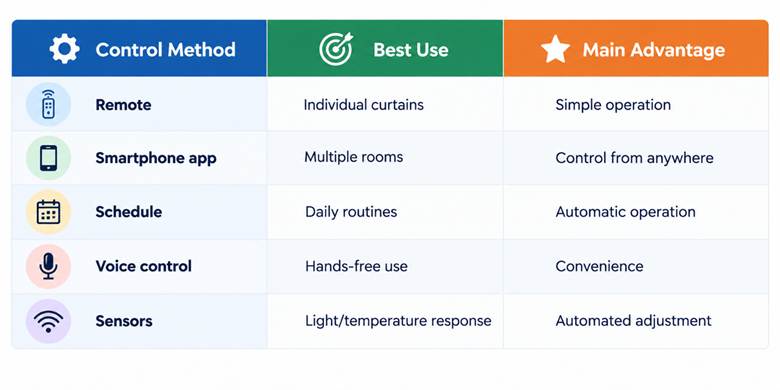
Depending on the product, control options may include:
- Remote control
- Wall-mounted control panels
- Smartphone applications
- Scheduled opening and closing
- Voice commands
- Light or temperature sensors
- Integration with smart-home systems
- Manual override options
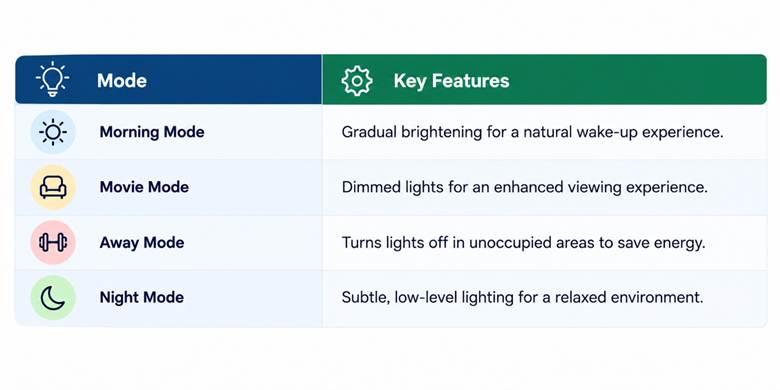
For example, homeowners can schedule curtains to open in the morning and close in the evening. Curtains can also be incorporated into scenes such as Movie Mode, Good Morning, or Away Mode.
This makes automated window curtains for home more than a luxury feature when they are properly integrated into everyday routines.
2. How to Choose the Right Smart Curtains for Your Home
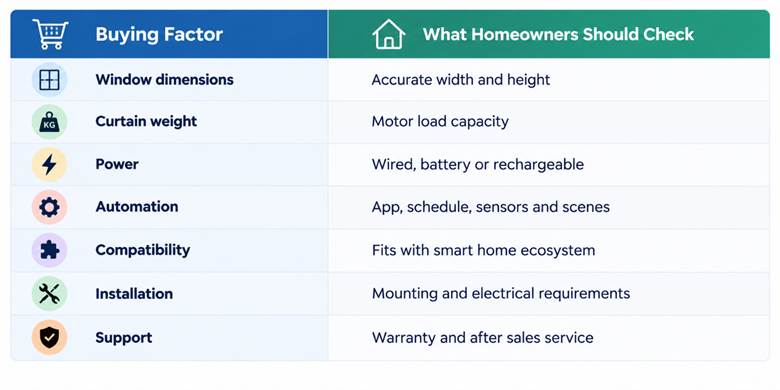
Choosing the right system involves more than selecting a curtain fabric or motor. Homeowners should first understand their window dimensions, curtain weight, mounting arrangement, power availability, and desired automation features.
Consider these factors before purchasing:
1. Curtain weight and size:
The motor must be appropriate for the curtain’s dimensions and weight.
2. Opening style:
Determine whether the curtain should open from the centre, one side, or both sides.
3. Power requirements:
Check whether the system requires wired electrical power, rechargeable batteries, or another power solution.
4. Control compatibility:
If you already have a smart-home platform, confirm compatibility before buying.
5. Noise:
For bedrooms and living spaces, quieter motor operation can improve the experience.
6. Manual operation:
A manual override can be useful if the system temporarily loses power or connectivity.
DOE guidance on window products also emphasizes factors such as cost, aesthetics, durability, maintenance, thermal comfort, glare control, and other practical considerations rather than focusing on energy performance alone.
How do I choose the right smart curtain motor?
Choose a motor that can handle the size and weight of your curtains.
3. Smart Curtain Automation: Remote, App & Voice Control
One of the biggest advantages of automatic window curtains is the range of control options.
With a connected system, a homeowner could open bedroom curtains using a scheduled routine, close living-room curtains at sunset, or operate several rooms from a smartphone.
Voice control can also provide hands-free operation where supported. More advanced systems can connect curtain operation with other home-automation devices.
The Department of Energy has also documented automated shading systems that integrate sensors and controls to manage daylight and solar conditions.
4. Benefits of Automated Curtains for Comfort, Privacy & Energy Efficiency
The strongest reason to install automated curtains is not simply that they look modern. Their value comes from combining convenience with intelligent control.
Comfort and Convenience
Curtains can operate automatically according to routines, reducing the need to repeatedly adjust them throughout the day.
Privacy
Scheduled closing can provide greater privacy during evening hours without requiring manual operation.
Daylight Management
Automated curtains can help control excessive brightness and glare while still allowing useful natural light into the room.
Potential Energy Benefits
Window coverings can influence heat gain and heat loss. DOE research notes that suitable window attachments can improve home energy performance, while automated shading can provide additional savings potential.
However, energy savings are not guaranteed. They depend on window orientation, glazing, curtain/shade type, climate, automation settings, and how the system is used.
A DOE-recognized residential pilot involving automated shades reported that some participants experienced utility-bill reductions of up to 14%, but this was a specific pilot involving particular homes and conditions—not a universal saving figure for every automated curtain installation.
5. Smart Curtains vs Traditional Curtains: Which Is Right for Your Home?
Traditional curtains remain practical for homeowners who mainly want affordable decoration, privacy, and basic light control. Automated curtains become more attractive when convenience, accessibility, scheduling, or whole-home automation is important.
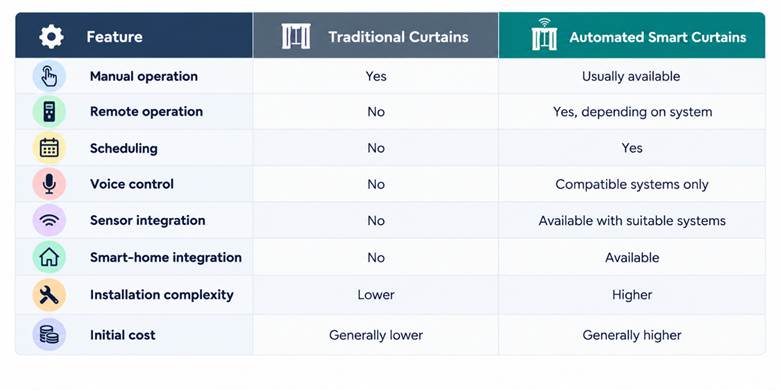
Therefore, the right choice depends on priorities. A homeowner with a few small windows may prefer traditional curtains, while someone building a connected home may value centralized automation across multiple rooms.
Conclusion
Are Automated Window Curtains Worth It for Modern Homes?
Automated curtains can be a worthwhile addition to a modern home when the homeowner values convenience, privacy, daylight management, and integration with other smart-home functions.
The key is to choose the system based on the actual requirements of the home rather than purchasing solely for its appearance. Motor capacity, curtain weight, power supply, compatibility, control options, installation quality, and after-sales support all affect the long-term experience.
Are smart curtains better than traditional curtains?
Smart curtains add scheduling, remote control, voice control, sensors, and smart-home integration, while traditional curtains offer simpler operation.
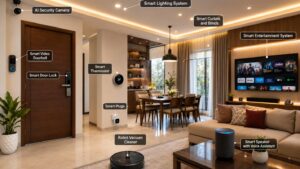
For homeowners planning a complete smart-home setup, automated smart curtains can become part of a broader ecosystem that connects lighting, climate control, security, and entertainment.
Ready to upgrade your home’s window control? Contact Insta Automations to explore a customized automated curtain solution designed around your windows, lifestyle, and smart-home requirements.
FAQs
1. What are automated window curtains?
Automated window curtains are motorized curtains that can open and close electronically using controls such as remotes, wall switches, smartphone apps, schedules, sensors, or compatible voice assistants.
2. Can I use automated window curtains in any room?
Yes, they can be installed in bedrooms, living rooms, home theatres, dining areas, offices, and other suitable spaces, provided the motor and mounting system are appropriate for the window and curtain.
3. Can automatic window curtains work with voice assistants?
Many smart curtain systems support voice control through compatible smart-home platforms. Compatibility should be checked before purchasing because supported platforms vary between products.
4. Do automated curtains save electricity?
They can potentially contribute to energy savings by controlling daylight and solar heat gain, but savings vary significantly depending on the window, curtain material, climate, orientation, and automation strategy. DOE research supports the energy-management potential of automated shading but does not establish one universal saving percentage.
5. Are automated smart curtains worth the additional cost?
They can be worthwhile for homeowners who value automated routines, remote control, privacy, accessibility, and smart-home integration. The decision should consider the complete installation cost, expected usage, motor quality, compatibility, maintenance, and long-term convenience.